


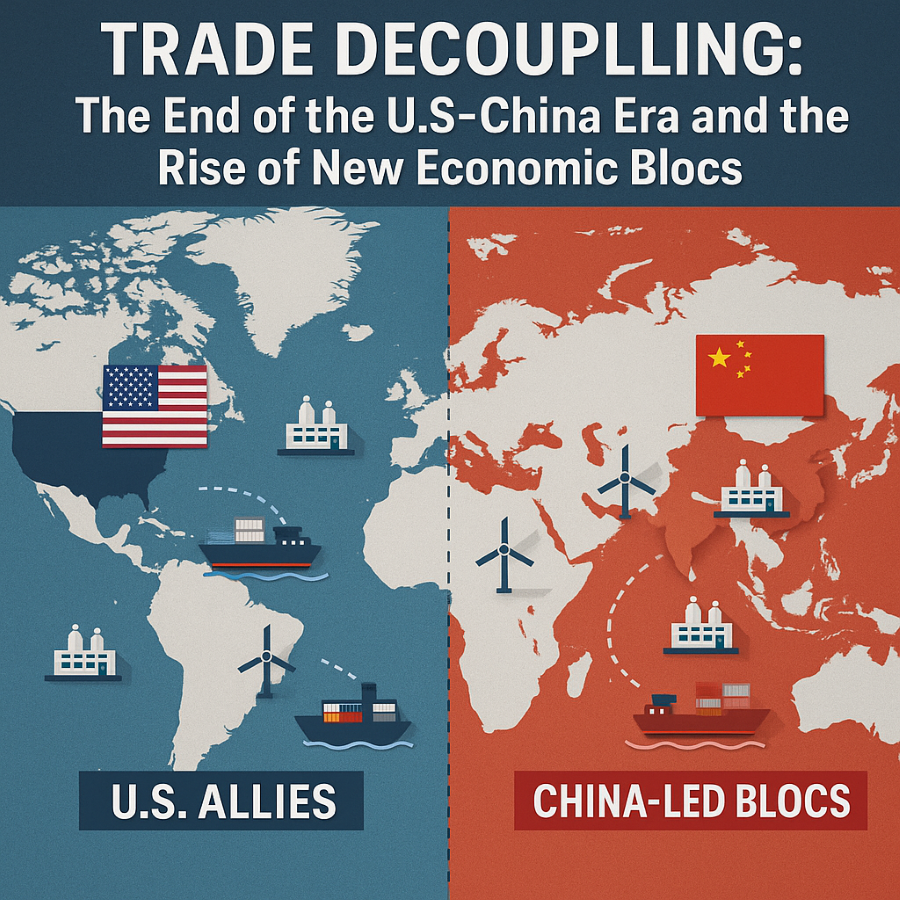
In recent years, global trade has entered a new era. Once dominated by the U.S.-China economic relationship, the world is now witnessing a shift—what many are calling trade decoupling. But what does this mean for your finances, your investments, and the global economy at large?
Let’s explore how this trend is reshaping markets and how you can adapt your strategies to thrive.
What Is Trade Decoupling?
Trade decoupling refers to the gradual unwinding of economic interdependence between the United States and China. This includes:
- Reduced imports/exports between the two countries
- Restrictions on technology transfers
- Reshoring and nearshoring of manufacturing
- National security-driven trade policies
The reasons behind this shift include geopolitical tensions, supply chain disruptions, and rising economic nationalism.
Why the U.S.-China Economic Relationship Is Changing
1. National Security Concerns
The U.S. has imposed strict regulations on Chinese tech companies, citing national security. This has led to bans on certain hardware and software, which in turn has prompted China to build its own alternatives.
2. Supply Chain Shocks
The COVID-19 pandemic exposed the vulnerability of global supply chains. As a result, countries are looking to diversify and shorten their production networks.
3. Political Pressures and Tariffs
The ongoing trade war, marked by tit-for-tat tariffs, has encouraged companies to explore other trading partners, further weakening the U.S.-China trade bond.
The Rise of New Economic Blocs
With the old structure fading, new alliances are forming:
– ASEAN and RCEP
Southeast Asia is becoming a manufacturing hub. The Regional Comprehensive Economic Partnership (RCEP) is strengthening ties among Asian economies.
– The European Union’s Strategic Autonomy
Europe is seeking to reduce dependence on both U.S. and Chinese imports, investing heavily in green tech and semiconductor independence.
– BRICS+ Expansion
With the inclusion of new members like Saudi Arabia and Iran, BRICS+ is emerging as a counterweight to Western-dominated financial systems.
How Trade Decoupling Affects Global Markets
- Increased market volatility due to uncertain trade policies
- Opportunities in emerging markets as new production centers rise
- Shift in investment patterns, particularly in energy, semiconductors, and infrastructure
- Stronger role of regional trade agreements in global commerce
Smart Investment Moves in a Decoupling World
Here are a few strategies to consider:
- Diversify International Exposure
Invest in ETFs and funds that track multiple emerging markets rather than relying heavily on China or U.S. stocks. - Focus on Strategic Sectors
Energy, semiconductors, rare earths, and defense technologies are gaining strategic importance. - Look at Trade-Friendly Regions
Countries like Vietnam, India, and Mexico are attracting new manufacturing and capital flows. - Consider Green Investments
As Europe and others invest in clean energy and supply chain independence, green assets are poised to grow. - Stay Informed on Policy Shifts
Trade policies can change quickly. A solid understanding of geopolitics is now a key part of smart investing.
Final Thoughts: Adapt and Prosper
The decoupling of the U.S. and China is more than a headline—it’s a transformational shift in global economics. For investors, entrepreneurs, and everyday consumers, this means new risks but also fresh opportunities.
